Kubernetes 1.32’s Native Sidecar Containers Just Went GA, and This Changes Everything About How We Deploy Service Meshes
The Feature That Spent 16 Months Proving Itself
Kubernetes 1.32 arrived in December 2024 with something that looked quiet on the surface but carries serious implications for anyone running service meshes or complex multi-container pod architectures. Native sidecar container support officially reached General Availability, which means the CNCF team has deemed it stable enough for production workloads without the disclaimer asterisks.
This isn’t a rushed promotion. The feature first landed as alpha back in August 2023 with version 1.28, giving the community sixteen months to stress-test it, find edge cases, and prove the concept actually solved real problems. That’s the kind of deliberate progression that usually indicates the Kubernetes maintainers genuinely believe in what they’re releasing. I’ve seen features burn through stable labels only to get quietly reverted two quarters later, so the fact that native sidecars made it through this long soak period tells you something.
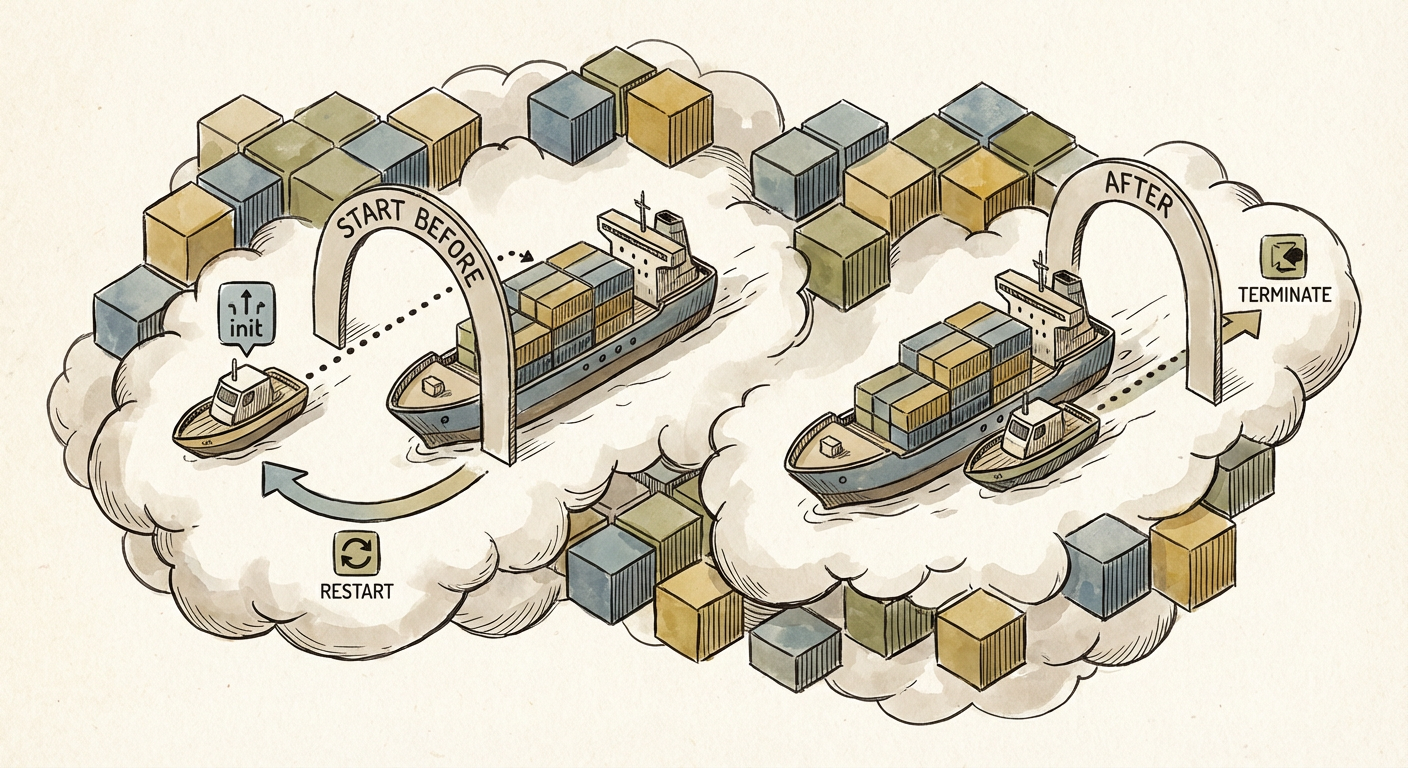
The mechanism itself is elegant. Instead of relying on admission webhooks and the old init container dance that every service mesh implementation had to cobble together differently, Kubernetes now offers a native solution using an initContainers field with restartPolicy set to Always. This simple addition changes the entire lifecycle equation: sidecars start before your main containers and terminate after them, exactly when you need them to, without requiring the workarounds that made debugging production incidents a special kind of frustrating.
Why This Matters More Than the Release Notes Suggest
The Istio team published their findings in early 2025, and the numbers are genuinely interesting. For workloads running in high-churn environments, pod startup latency dropped by up to 50 percent compared to the legacy injection model that’s dominated for years. Fifty percent. That’s not a marginal improvement you celebrate with a minor blog post and move on. That’s the kind of reduction that changes how you think about rolling updates, autoscaling behavior, and the feasibility of certain deployment patterns.
Think about what that means practically. Every time your cluster scales up, every canary deployment, every blue-green transition, every time a pod gets evicted and rescheduled, you’re saving milliseconds that accumulate into seconds that accumulate into measurable business impact. In environments where you’re spinning up dozens of pods per minute, that efficiency compounds fast.
Linkerd’s maintainers went even deeper with their benchmarking work, and they uncovered something that doesn’t always make it into the headlines: native lifecycle management eliminated an entire class of race-condition bugs responsible for approximately 8 percent of their reported production issues throughout 2024. These weren’t cosmetic bugs. These were the intermittent failures that show up at three in the morning in your least favorite deployment, the ones that take hours to reproduce in a test environment because they depend on precise timing windows.
The Adoption Picture Is Clear
The broader ecosystem context matters here. According to the CNCF Annual Survey 2025, 84 percent of respondents were already running Kubernetes in production, and service mesh adoption has climbed to 52 percent, up from 42 percent just two years prior. That trajectory tells you exactly how much pressure exists to solve the sidecar injection problem elegantly.
When more than half your user base is running service meshes, and you know that sidecars represent a meaningful portion of the complexity and fragility in those deployments, fixing the fundamental mechanism isn’t a nice-to-have. It’s table stakes. The native sidecar feature arrives at precisely the moment when the community needed it most.
This also explains why we’re seeing validation implementations show up from multiple service mesh projects simultaneously. When the Kubernetes team provides a native mechanism, everyone stops reimplementing the same workaround independently and converges on the standard approach. The ecosystem self-corrects toward simplicity.
What This Means for Your Infrastructure
If you’re running Istio, Linkerd, or any other mesh implementation, you should already be thinking about migration paths. The performance gains alone justify the planning effort, but the stability improvements matter more. Race conditions are expensive. They’re unpredictable, they’re hard to test for, and they generate support tickets that consume everyone’s time.
For organizations still on older Kubernetes versions, the Kubernetes 1.32 Release Notes are worth reading end-to-end, but native sidecar support should probably land somewhere in your upgrade decision matrix. It’s not the only reason to upgrade, but it’s a solid anchor point for cost-benefit discussions with your platform team.
The implementation details are also worth understanding if you maintain custom sidecar deployment logic. The restartPolicy field gives you explicit control over restart behavior, which means you can finally stop writing bash scripts that check if sidecars are healthy and then manually restart them when they’re not. Let Kubernetes handle it.
The Quiet Revolution
What strikes me about this release is how understated it is for something so consequential. No major announcements. No dramatic demos. Just a feature that silently makes your infrastructure more reliable, faster, and easier to reason about. That’s the mark of good platform work.
The sidecar container pattern isn’t new, and Kubernetes isn’t the first orchestrator to support it natively. What’s remarkable is that after all these years of service meshes growing in complexity and adoption, the platform finally caught up with a first-class implementation that the ecosystem actually wanted. The sixteen months in alpha, combined with real benchmarks from multiple high-profile projects, suggests the Kubernetes maintainers took the job seriously.
If you’ve been tracking Kubernetes developments closely, this deserves a spot on your radar. If you haven’t thought about it yet, now’s probably a good time to start. What’s your current approach to sidecars? Are you considering the native implementation for your next upgrade cycle? The production feedback from early adopters is going to shape how this feature evolves over the next few releases.

How to Share Files Through iCloud Drive Without the Usual Headaches
NIST CSF 2.0 at One Year: Why Engineering Teams Keep Botching the Govern Function
The SQLite ANALYZE Command Nobody Talks About (And Other Database Performance Secrets That Actually Work)
About Author
